



Exploring the Mystery of Reading Through Eye Movements
Have you ever found yourself forgetting what you read earlier while working through a long passage in another language? Even when reading the same text, people read in different ways. What exactly happens in our minds when we read? Assistant Professor Nahatame is exploring this mystery by studying eye movements.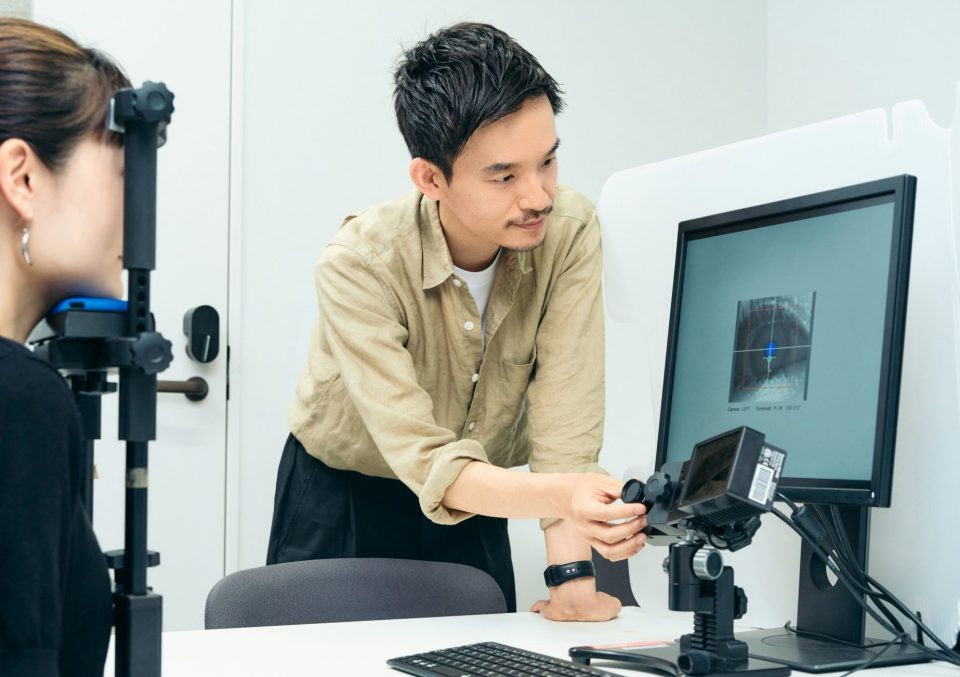
Understanding Why Reading Can Be Difficult
I have always enjoyed reading and studying English, and I originally hoped to become an English teacher. As a native speaker of Japanese, I was particularly struck by how much effort reading in English could require. When preparing for entrance examinations, I found it difficult to finish reading passages within the allotted time or to understand texts containing unfamiliar words. I wondered why reading in a foreign language felt so much harder than reading in Japanese.
When I learned about “working memory” at university, things began to make sense. Reading requires us to process language while retaining information we have already read. When reading in a foreign language, however, processing individual words and sentences can demand so much mental effort that we have little capacity left to remember what came before. I found it fascinating that academic research could explain the difficulties I had experienced myself, and my interest in English reading comprehension deepened.
What eventually led me into research was my encounter with studies of reading comprehension using eye-tracking technology. I began using this approach in my doctoral dissertation and have continued working with it ever since. Although I had pictured myself teaching English, I became so fascinated by uncovering how people read that my intellectual curiosity ultimately won out.
How Eye-Tracking Data Covering 410,000 Words Are Generating New Knowledge
Eye tracking allows us to record which words readers look at, how long they fixate on them, which words they skip, and where they move their eyes backward to reread earlier text. By analyzing these eye movements, we can investigate factors associated with reading difficulty and differences in how individuals read.
We asked 41 undergraduate and graduate students whose native language was Japanese to read approximately 10,000 words of English each, collecting eye-tracking data covering a total of about 410,000 words. Each participant spent two to three hours completing the eye-tracking session. It then took us another six months or so to check and organize the recordings.
The result was the Tsukuba Eye-tracking Corpus (TECO). We aligned the words in the texts with readers’ eye movements and released the dataset in 2024 as a corpus that other researchers could also analyze. There are questions we cannot fully investigate on our own, but researchers around the world may uncover new findings by examining the data from different perspectives. The corpus is already beginning to lead to new collaborations with researchers in other disciplines and overseas.
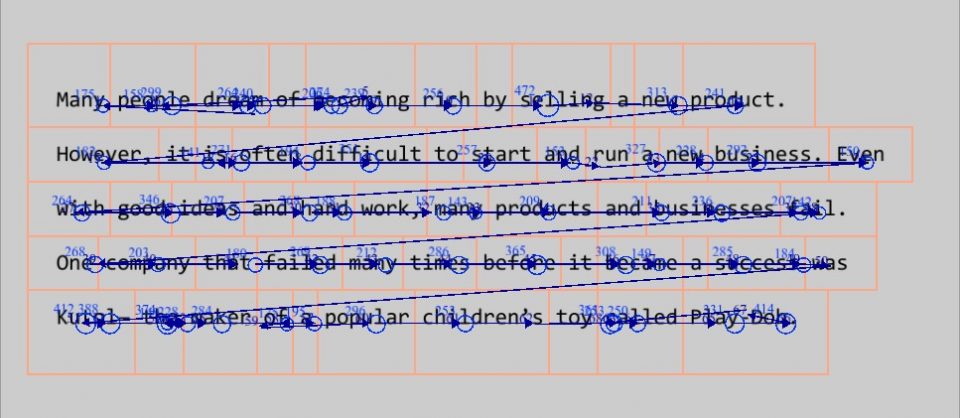 Figure: Example visualization of eye-tracking data recorded during English reading.
The blue circles indicate where the reader’s gaze paused, the lines show the paths of eye movements, and the orange boxes highlight the words being analyzed. These data make it possible to examine how long readers look at individual words, which words they skip, and where they return to reread text.
Beyond the Differences: Discovering Shared Mechanisms of Reading
Native English speakers and people learning English as a foreign language differ in their reading speed and how frequently they move their eyes backward to reread text. Previous research has focused on these differences. However, when we compared our eye-tracking data with findings from earlier studies of native speakers, we also began to identify common factors that influence reading.
For example, word length affects whether a reader skips a word, while word frequency and predictability from context influence how a word is processed when first encountered and whether the reader returns to it. These effects have also been documented in studies of native speakers. To explore reading mechanisms that may be shared between first-language and foreign-language reading, I am now expanding my research to include reading in Japanese and how native English speakers read English.
Our research using artificial intelligence (AI) has also raised new questions. In a study we published in 2026, we found that objective measures of English text difficulty, including AI-based assessments and well-known readability measures, closely aligned with learners’ average ratings of difficulty. At the same time, differences between each learner’s rating and the group average also helped explain their eye-movement patterns. Looking only at average trends is not enough to capture how each individual reads.
Even as AI makes translation easy, advanced reading comprehension skills are needed to judge whether a translation is accurate and whether a version in a foreign language preserves the nuances originally expressed in one’s first language. In this age of AI, I believe that exploring what makes human reading distinctive can offer valuable insights into the future of English language education.
Above all, there is still so much we do not understand about how humans read. My curiosity to uncover more of these mysteries continues to drive my research.