


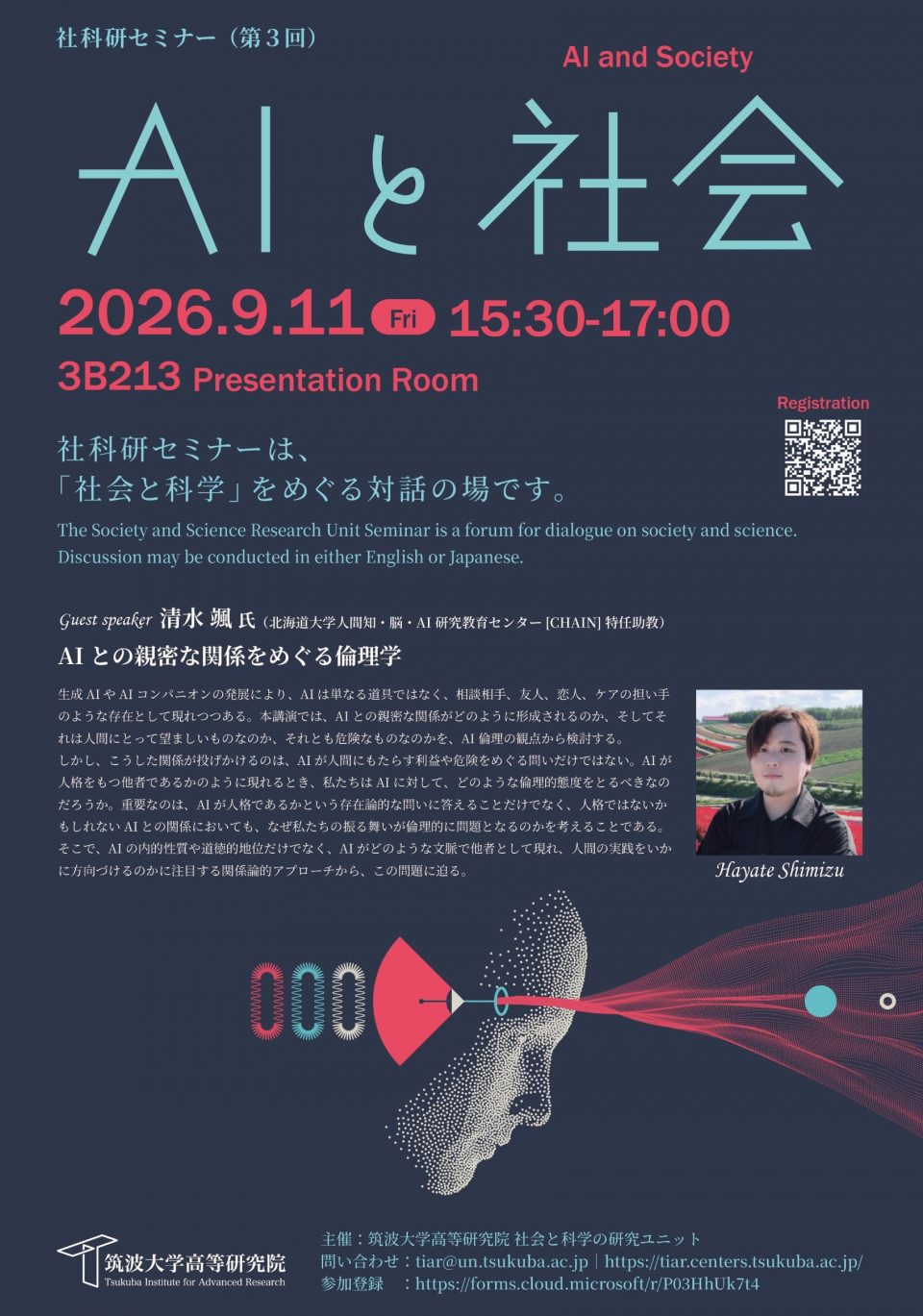
Session 3
Date & Time: Friday, September 11, 2026, 15:30–17:00
The Ethics of Intimate Relationships with AI
Guest Speaker: Hayate Shimizu, Assistant Professor, Center for Human Nature, Artificial Intelligence, and Neuroscience (CHAIN), Hokkaido University
With the advancement of generative AI and AI companions, AI is increasingly emerging not merely as a tool but as a conversational partner, friend, romantic companion, or even caregiver. This lecture explores how intimate relationships with AI are formed and whether such relationships should be considered beneficial, harmful, or something in between from the perspective of AI ethics.
However, these developments raise more than questions about the benefits and risks of AI for humans. When AI appears as if it were a person-like other, we are also confronted with the question of what kind of ethical attitude we ought to adopt toward AI itself. The crucial issue is not only whether AI genuinely possesses personhood, but also why our conduct toward AI may be ethically significant even if AI is not a person.
To address this issue, the lecture adopts a relational approach that focuses not only on AI’s internal properties or moral status, but also on the contexts in which AI appears as an “other” and the ways in which it shapes human practices and interactions. Through this lens, the speaker will examine the ethical implications of increasingly intimate human–AI relationships.
Session 2
Date & Time: Friday, August 28, 2026, 15:30–17:00
Bridging Research and Society: Perspectives Needed to Deliver Good Research to the Real World
Guest Speaker: Katsumasa Nagano
Drug Discovery and Healthcare Innovation Group, Drug Discovery & Health Ecosystem Division, Mitsubishi Research Institute, Inc.
Outstanding research does not necessarily translate into social impact. In addition to scientific novelty and academic validity, researchers must understand the diverse evaluation criteria and decision-making processes employed by industry, healthcare professionals, policymakers, and other stakeholders.
Drawing on experience in drug discovery research, clinical development, medical affairs, and policy research, this seminar explores the “translation gap” that often arises between research outcomes and their practical application in society. Through examples such as promising drug-discovery seeds that fail to reach implementation and factors influencing the adoption of medical technologies, the speaker will discuss how researchers can articulate the social value of their work and identify the data, implementation environments, and collaborative partners necessary for successful societal impact.
The seminar will further consider what kinds of questions researchers should ask in order to bridge the gap between research and society. Rather than viewing social implementation solely as the result of individual effort, it will be examined as a structural process shaped by institutions, organizations, and social practices. Participants will be encouraged to think about pathways through which research potential can be transformed into tangible social value.

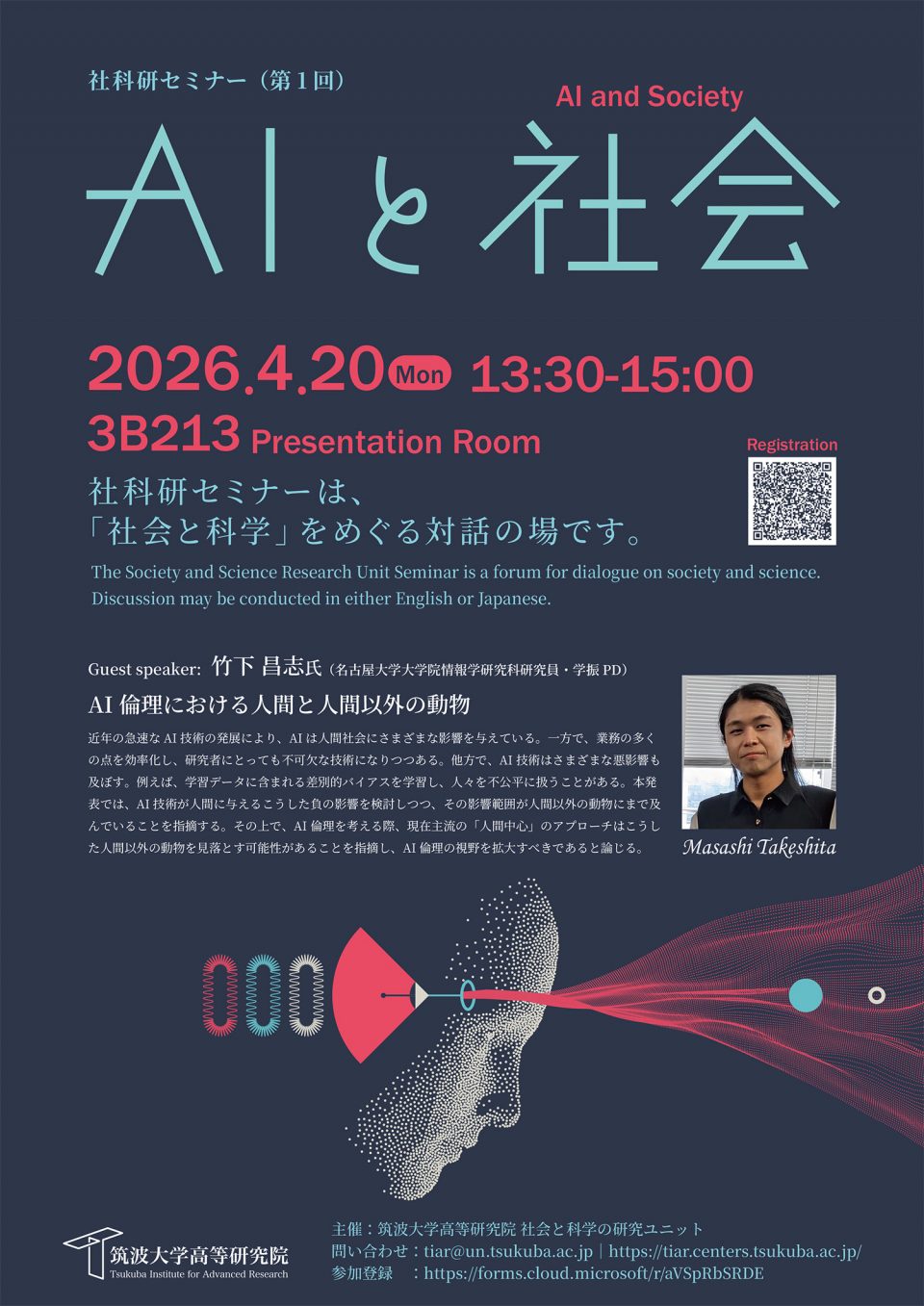
Session 1
Date & Time: Monday, April 20, 2026, 13:30–15:00
Humans and Nonhuman Animals in AI Ethics
Guest Speaker: Masashi Takeshita, Ph.D. Candidate (JSPS Research Fellow PD), Graduate School of Informatics, Nagoya University
Recent rapid developments in artificial intelligence (AI) have had a wide range of impacts on human society. On the one hand, AI has improved the efficiency of many tasks and is becoming an indispensable technology for researchers and professionals alike. On the other hand, AI systems can also produce significant negative consequences. For example, AI may learn discriminatory biases embedded in training data and consequently treat people unfairly.
This presentation examines such adverse effects of AI on human beings while highlighting that the scope of these impacts extends beyond humans to nonhuman animals. It argues that the currently dominant human-centered approach in AI ethics may overlook the interests and welfare of nonhuman animals. The speaker will therefore advocate for broadening the scope of AI ethics to encompass ethical concerns relating to nonhuman animals.