


Background: Improving health through a whole-of-society approach
The Constitution of the World Health Organization (WHO) defines health not merely as the absence of disease or infirmity, but as “a state of complete physical, mental, and social well-being”. The right to health is recognised as a fundamental human right, including in the Universal Declaration of Human Rights and other international treaties.
The 2030 Agenda for Sustainable Development also emphasise the importance of health and well-being through Goal 3: “Ensure healthy lives and promote well-being for all at all ages.” Despite global commitments, many health-related targets, including those concerning infectious diseases, non-communicable diseases, maternal and child health, and universal health coverage (UHC), remain off track for achievement by 2030. One of the reasons is that global health efforts are often fragmented, resulting in inefficient and insufficient implementation at global, regional, and national levels, failing to address the multiple and interconnected factors that influence health and well-being.
 Notably, health inequalities cannot be explained solely by individual choices or personal responsibility. Health is profoundly shaped by the social and economic conditions in which people are born, grow, live, work, and age. These factors are referred to as the social determinants of health, which include education, employment, income, housing, and social relationships, among others.
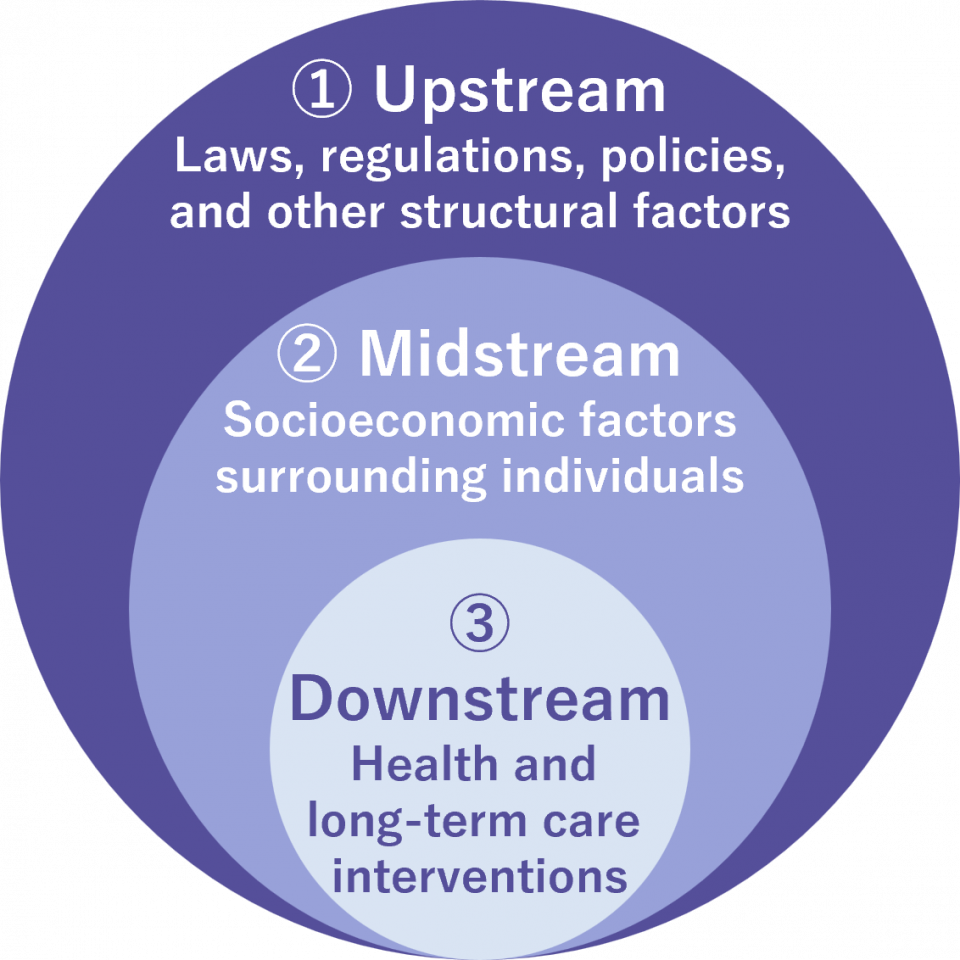
To avoid siloed approach, this research adopts an integrated perspective encompassing:
- Upstream interventions, which address the broader social, economic, and structural determinants of health;
- Midstream interventions, which respond to individual and community needs for prevention and health promotion efforts; and
- Downstream interventions, which ensure equitable access to quality health and long-term care services at affordable costs.
Research Theme 1: Society, economy, and health
Health is shaped largely outside the health sector. Despite increasing attention to the social determinants of health, comprehensive quality evidence on the effects of education, employment, income, social connectedness, and living conditions across the life course remains limited both in Japan and internationally.
Analysing nationally representative survey data from Japan and cross-national macro-level indicators using econometric and other quantitative methods, this theme will assess health inequalities and investigate the socioeconomic factors that influence health and well-being throughout the life course. It will also explore effective policy strategies and implementation mechanisms for expanding social protection and improving access to health-related services. Ultimately, the theme aims to inform policy design and contribute to evidence-based policymaking in health and social policy.
Research Theme 2: Universal health coverage
UHC means that all people can access quality health services whenever they need them without experiencing financial hardship. UHC not only promotes better health outcomes but is also a cornerstone of sustainable and equitable social and economic development. Health systems strengthening based on a primary health care approach is widely recognised as the most inclusive, equitable, and cost-effective way to achieve UHC.
 Despite global political commitments, the progress towards UHC has been off track: more than half of the world population still lacks access to essential health services, and 2.1 billion face financial hardship due to out-of-pocket health spending. However, at the same time, population ageing, the growing burden of non-communicable diseases, and workforce shortages in the health and care sector pose additional challenges to the sustainability and equity of health and long-term care systems.
Therefore, this theme will conduct policy-oriented research on:
- disease prevention and health promotion using administrative and population-level data;
- improving metrics for monitoring and evaluating progress towards UHC; and
- supporting the development of sustainable and equitable health and long-term care systems in ageing societies.
Approach
Drawing on the Principal Investigator’s expertise in health and social policy and health economics, the project will adopt an interdisciplinary approach and collaborate with Japanese and international experts from universities, WHO, and other policy-relevant organisations across a range of fields, including economics, psychology, sociology, gerontology, social medicine, epidemiology, and global health.
Through policy-oriented research, the project seeks not only to advance academic knowledge but also to contribute to addressing societal challenges and to inform relevant policies, international dialogues, and global frameworks.
Publications
- Occhipinti JA, Prodan A, Buchanan J, Martin M, Khalatbari-Soltani S, Swieboda P, Eyre H, Crosland P, Hossein SH, van Zwieten A, Samtani S, Sawan M, Cobos DM, Okamoto S, Robinson J, Norris D, Jeste DV, Destrebecq F, Heffernan M, Tanner M, Miranda JJ (2026) Governing the social production of care: the hidden foundation of health systems. Nature Medicine. https://doi.org/10.1038/s41591-026-04535-y
- Okamoto S, Yamada A, Kobayashi E, Liang J (2025) Socioeconomic inequity in access to medical and long-term care among older people.International Journal for Equity in Health. 24; 28. https://doi.org/10.1186/s12939-024-02345-7
- Rosenberg M, Kowal P, Rahman M, Okamoto S, Barber S, Tangcharoensathien V (2023) Better data on unmet healthcare need can strengthen global monitoring of universal health coverage. BMJ. 382; e075476. https://doi.org/10.1136/bmj-2023-075476
- Okamoto S, Kobayashi E, Komamura K (2023) The retirement-health puzzle: A sigh of relief at retirement. The Journals of Gerontology, Series B: Psychological Sciences and Social Sciences. 78(1): 167-178. https://doi.org/10.1093/geronb/gbac127
- Tanaka T, Okamoto S (2021) Increase in suicide following an initial decline during the COVID-19 pandemic in Japan. Nature Human Behaviour, 5, 229–238. https://doi.org/10.1038/s41562-020-01042-z
- Okamoto S, Kobayashi E (2021) Social isolation and cognitive functioning: A quasi-experimental approach. The Journals of Gerontology. Series B, Psychological Sciences and Social Sciences, 76 (7): 1441-51. https://doi.org/10.1093/geronb/gbaa226