



Background: Viewing Nature as Part of Infrastructure
Cities and coastal regions are highly vulnerable to the impacts of climate change. Traditionally, risks such as flooding, storm surges, and coastal erosion have largely been addressed through “grey infrastructure”, including seawalls, levees, and concrete flood barriers. While these structures remain important, they can be costly to maintain, inflexible under changing climatic conditions, and potentially damaging to surrounding ecosystems.
Nature-based Solutions (NbS) recognise healthy ecosystems as part of infrastructure. Mangroves, for example, can reduce wave energy, wetlands can store floodwater, and urban green spaces can help cool cities. In addition to reducing disaster risks, these natural functions can provide multiple benefits, including biodiversity conservation, carbon storage, and improved human well-being.
NbS have become increasingly important in international climate and biodiversity policy. However, their implementation often remains limited to small-scale demonstration projects, while scientific evidence is fragmented across disciplines and regions. Challenges also remain in determining appropriate institutional and governance arrangements and ensuring that the costs and benefits of NbS are shared equitably across society.
This project investigates the conditions under which NbS can function effectively and how natural systems can best be combined with engineered structures. It also aims to connect scientific evidence with policy and infrastructure planning, helping move NbS beyond isolated pilot projects towards their wider integration into the infrastructure that supports society.
Research Theme 1: Transforming Urban Infrastructure with Nature-based Solutions
Cities are highly vulnerable to climate change impacts such as flooding and urban heat, but they also provide important opportunities for infrastructure innovation. This research theme examines how NbS can move beyond isolated demonstration projects to become an integral part of urban planning and infrastructure policy.
Cities are viewed as interconnected systems of society, ecosystems, and technology. We investigate how governance arrangements, public perceptions, and equity considerations influence the implementation of NbS. The research also develops decision-support approaches to help governments plan climate-resilient urban infrastructure that takes both the natural environment and local communities into account.
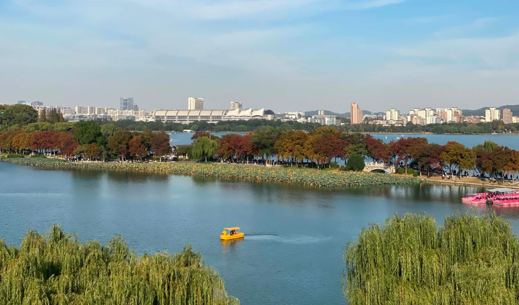
Fieldwork on urban greenery in Nanjing, China
Research Theme 2: Transforming Coastal Infrastructure with Nature-based Solutions
Coastal regions face growing risks from sea-level rise, coastal erosion, storm surges, and extreme weather. At the same time, conventional infrastructure such as seawalls and breakwaters can involve increasing construction and maintenance costs and place additional pressure on surrounding ecosystems.
This research theme compares a range of approaches, from natural coastal protection using restored mangroves, wetlands, and coral reefs to hybrid approaches that combine natural systems with engineered structures. In addition to their effectiveness in reducing coastal hazards, we examine governance, economic feasibility, and public acceptance to identify where natural approaches may be sufficient and where hybrid solutions are needed. The findings will inform long-term coastal infrastructure planning and climate change adaptation.
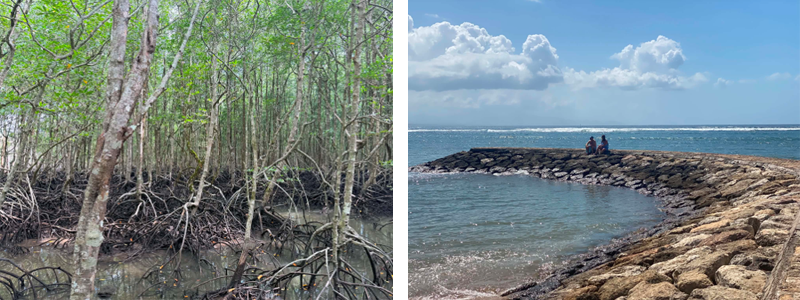
Left: Mangrove forest on Pulau Ubin, Singapore. Right: Breakwaters used for coastal protection in Sanur, Bali, Indonesia
Research Theme 3: From Scientific Evidence to Policy and Practice
Similar Nature-based Solutions may work effectively in one location but struggle to become established in another. Understanding why requires comparisons across countries and regions with different environmental conditions, social institutions, and governance systems rather than a focus on individual case studies alone.
This research theme systematically synthesises evidence from around the world and combines it with international comparative research to identify the environmental, institutional, and social conditions that support successful NbS implementation. The research develops context-sensitive recommendations to help governments, practitioners, and international organisations design more effective and equitable infrastructure policies. The findings also contribute to international policy discussions on climate change and biodiversity.
Approach
This project combines perspectives on social-ecological resilience, transitions in social and technological systems, and equity in the impacts of and responses to climate change. Rather than treating infrastructure as isolated engineering structures, we view it as part of an interconnected human–nature system. The research combines interdisciplinary framework development, systematic synthesis of global evidence, and comparative field studies in urban and coastal regions.
Researchers from ecology, engineering, urban and regional planning, economics, and the social sciences work together with governments, practitioners, international organisations, and local communities. Particular attention is given to the local knowledge and values of people living alongside coastlines, wetlands, and urban green spaces. By incorporating community perspectives and considerations of equity, the project seeks to connect scientific evidence with real-world policy and infrastructure planning.
Selected publications
- Huynh, L. T. M., Lam, R. D., Takama, T., & Gasparatos, A. 2026. Mobilising nature-based solutions (NbS) for coastal protection: Public preferences for hard, soft and hybrid coastal protection measures in Bali, Indonesia. Landscape and Urban Planning, 275, 105732. https://doi.org/https://doi.org/10.1016/j.landurbplan.2026.105732.
- Huynh, L.T.M., Su, J. Gasparatos. A. 2025. Differentiated trajectories of ecosystem-based adaptation for urban coastal defence in the Asian-Pacific region: A Biodiversity–Climate–Society nexus perspective. Ocean & Coastal Management. 270, 107799. https://doi.org/10.1016/j.ocecoaman.2025.107799.
- Huynh, L.T.M. et al. 2024. Meta-analysis indicates better climate adaptation and mitigation performance of hybrid engineering-natural coastal defence measures. Nature Communications. 15, 2870. https://doi.org/10.1038/s41467-024-46970-w
- Wannewitz, M., Ajibade, I., Mach, K.J. Magnan, A, Petzold, J., Huynh L.T.M et al. 2024. Progress and gaps in climate change adaptation in coastal cities across the globe. Nature Cities 1, 610–619. https://doi.org/10.1038/s44284-024-00106-9
- Huynh, L.T.M., Gasparatos. A, Su. J, Dam Lam. R, Grant. E, Fukushi. K. 2022. Linking the non-material dimensions of human-nature relations and human wellbeing through a cultural ecosystem services lens. Science Advances. 8 (31). DOI: 10.1126/sciadv.abn8042
- Berrang-Ford, L., Huynh, L.T.M et al. 2021. A Systematic Global Stocktake of Evidence on Human Adaptation to Climate Change. Nature Climate Change. 11: 989 – 1000. https://doi.org/https://doi.org/10.1038/s41558-021-01170-y.