


At the European Organization for Nuclear Research (CERN), located near Geneva, Switzerland, heavy ions are accelerated and collided using the Large Hadron Collider (LHC) to create the quark–gluon plasma (QGP), a state of matter that is considered to have existed in the very early universe immediately after the Big Bang. The LHC-ALICE experiment seeks to elucidate the properties of this QGP (Fig. 1). ALICE is one of the detectors installed in the LHC, and Assistant Professor Sekihata is conducting research with the approach of “identifying the initial state of the QGP phase using the ALICE detector”. Through this research, he aims to shed light on the conditions of the early universe and ultimately contribute to a more detailed understanding of its evolution.
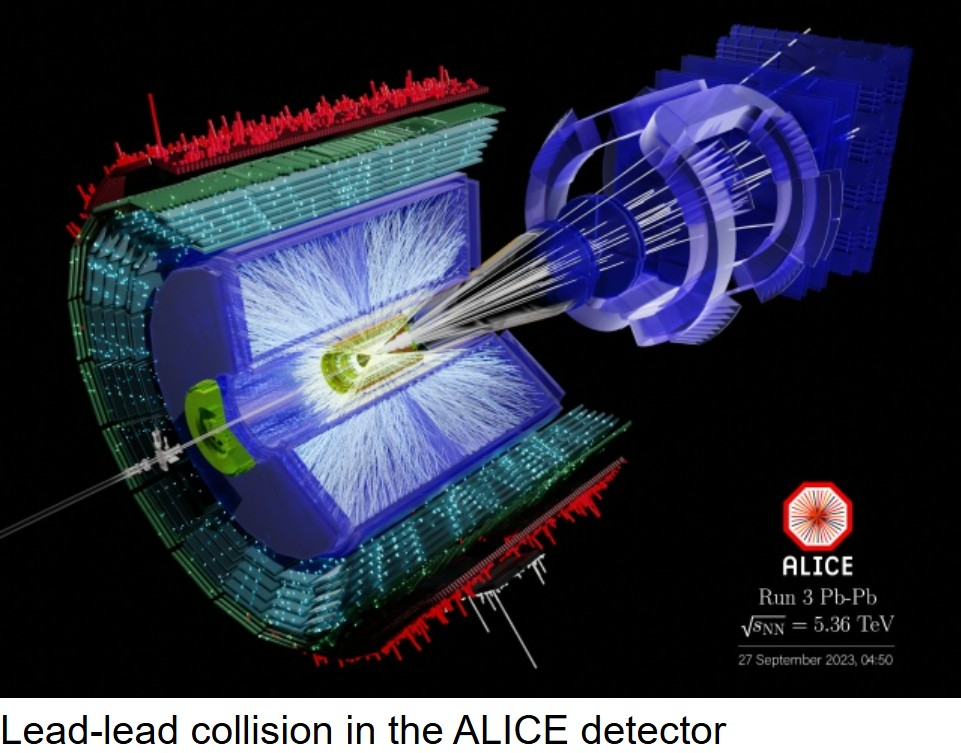
Source: https://cds.cern.ch/images/CERN-PHOTO-202309-223-1
Figure 1. Event display of a lead–lead collision reproducing the early universe approximately 10 microseconds after the Big Bang
Measuring the Temperature of the Quark–Gluon Plasma (QGP) Phase through an Analysis of Photon Energy Distributions from Thermal Radiation
In the LHC-ALICE experiment, lead nuclei are collided at nearly the speed of light to create the QGP phase, where quarks and gluons move freely under conditions of extremely high temperature and density. Virtual photons, which exist only for a very short time due to quantum mechanical effects, are emitted from this QGP as thermal radiation without interacting with other particles and subsequently decay into electron–positron pairs. Our experimental group detects and analyzes these signals using the ALICE detector. We simultaneously perform detector response simulations to evaluate detection efficiency and apply corrections to the measured values. Since these simulations require the precise reproduction of the spatial resolution of the actual data and the trajectories of the particles, we also place great emphasis on developing and improving the associated software.
If sufficient data may be collected such that the observed “slope of the photon energy distribution (Fig. 2)” falls within a certain margin of error, the temperature of the QGP phase is considered to be successfully measured. However, as of August 2025, the amount of data accumulated is only approximately 50% of the target. Since 2022, we have been using an upgraded detector, which has increased the amount of data that may be obtained by a factor of 100. Nevertheless, we are still only halfway there, and our goal is to complete the measurement by June 2026.
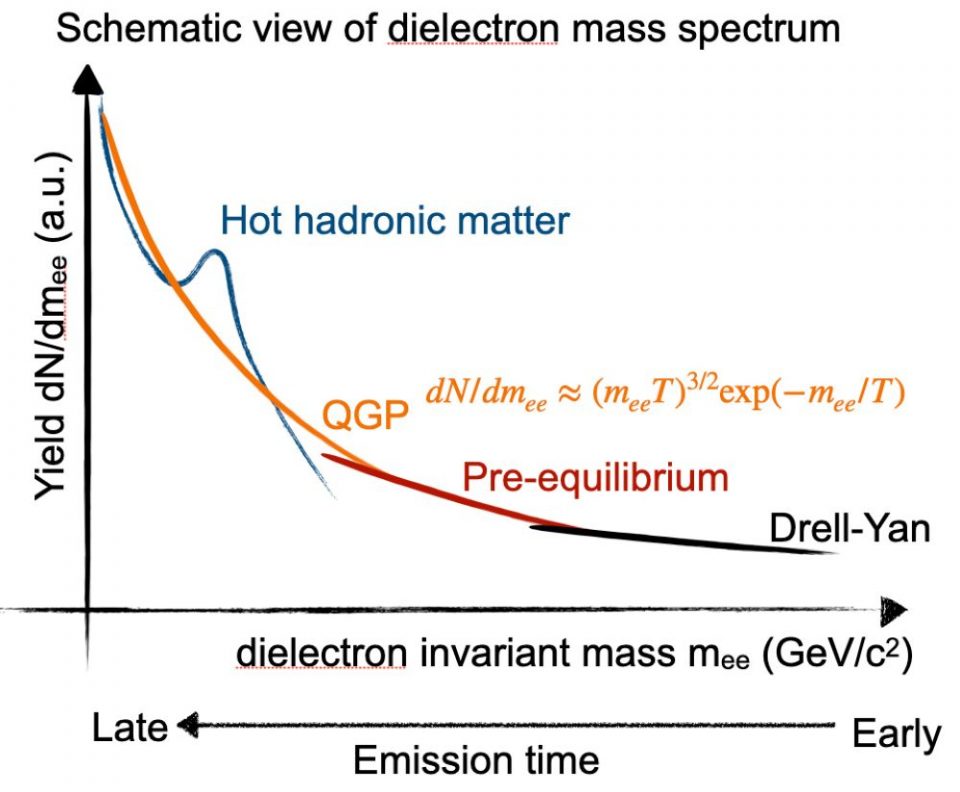
Figure 2. Slope of the invariant mass distribution of virtual photons decaying into electron pairs (Created by SEKIHATA Daiki)
Leading the Research Group as the Responsible Investigator
Our research group consists of about 20 researchers from different countries, including Germany and France, and I currently serve as both the group leader and the person responsible for data acquisition. Although I sometimes face various challenges, such as reconciling differences when assigning roles that researchers are reluctant to take on or providing direction when the research does not progress as planned, I also recognize the advantages and unique value of being in this position. For example, I am able to directly and immediately assess the quality of the data collected. Although discussions with international collaborators often extend for many hours, I draw on my physical stamina to remain fully engaged in the work on a daily basis.
From Elucidating the QGP Phase to Exploring the Evolution of the Universe
As the QGP phase cools, quarks bind together to form protons and other hadrons, a state known as the hadronic phase. In my previous research, I succeeded in detecting electromagnetic radiation that contributes to measuring the temperature of the hadronic phase. In the future, I aim to measure the angular distribution of photons and clarify the viscosity that characterizes the QGP phase. This represents a new challenge that has not been attempted before, mainly because of the limited availability of virtual photon data, and I hope to make it a research achievement that is uniquely my own.
Our ultimate aim is not only to elucidate how the QGP phase formed, but also to address the fundamental question of how the universe itself has evolved. To achieve this, I regard it as part of my mission as a university faculty member to share the excitement of experimentation with as many students as possible and to inspire their interest in science.
(Date of interview: June 29, 2025)