


“Acoustic levitation” uses ultrasound to levitate and manipulate objects, and “wavefront holograms” enable this technique to be realized with high precision. Through these technologies, Dr.Fushimi aims to fuse the digital world and physical world.
Manipulating Objects Using Ultrasonic Wavefronts
My research focuses on “acoustic levitation” and “wavefront holograms”. Acoustic levitation is a technology that uses ultrasound to levitate small objects and manipulate them as desired, while wavefront holograms are techniques that are used to generate fields for acoustic levitation.
To levitate objects, it is necessary to artificially design and reproduce the wavefronts of sound waves (acoustic fields). A wavefront is a surface connecting points that share the same phase. The circular ripples that spread outward when a stone is dropped into water are an example of a wavefront. Sound waves also have wavefronts in which the phase is aligned. By changing how these wavefronts are arranged, it is possible to concentrate acoustic forces at specific locations in space. This allows multiple objects to be manipulated simultaneously without directly touching them.
In 2014, the development of a “phased-array levitator” equipped with multiple “ultrasonic transducers” marked the beginning of full-scale research into non-contact manipulation technologies. A phased-array acoustic levitation system (Fig. 1) is a device that enables the stable levitation of objects in midair by precisely controlling ultrasonic interference. The ultrasonic transducers used in this system convert electrical energy into ultrasound and are key components that strongly affect overall system performance. Advances in electronic control technology have made it possible to control ultrasonic transducers dynamically and with high precision, enabling objects to be moved freely in the three-dimensional space while remaining completely contactless.
Acoustic levitation is expected to have broad applications in fields such as chemistry and medicine. In chemistry, automated experiments using robots are becoming increasingly common. However, if the transport and mixing of chemicals without contact becomes possible in the future, this process will become more efficient than with robotic handling and production costs will also be reduced.
To move objects freely without contact, it is essential to optimize the wavefronts required for manipulation. Therefore, I am working on both fundamental and applied research, including the development of technologies that design wavefronts through theoretical calculations, control ultrasonic transducers via computer control, and generate wavefront holograms tailored to specific objectives.
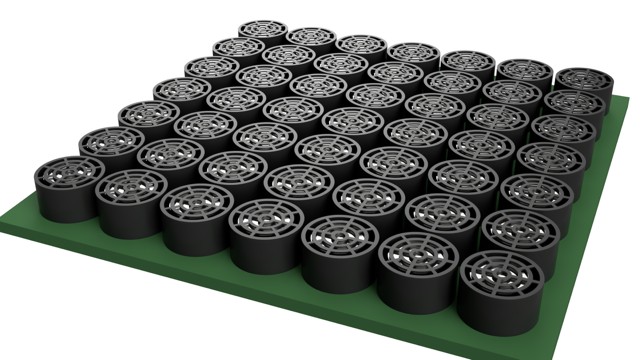
Figure 1. Ultrasonic phased array
An arbitrary acoustic field is generated by arranging multiple ultrasonic transducers in an array and adjusting the amplitude and phase of each element.
(Image provided by Yusuke Koroyasu, Digital Nature Laboratory, University of Tsukuba)
A Touchable Volumetric Projection Display
One application-focused research area that I am putting particular effort into is “a volumetric display” (Photo 1), which is realized by levitating an object using sound waves and moving the levitated object at high speed.
Using wavefront hologram technology, an object may be suspended at a specific position in space. By moving it rapidly, a persistence-of-vision effect is created, enabling a volumetric projection display that may be touched.
In addition, my laboratory has developed a method for automated chemical experiments by manipulating droplets placed on a hydrophobic mesh using focused ultrasound (Fig. 2), and a patent application has been filed for this technology (Japanese Patent Application No. 2024-018667).
Since technologies related to ultrasonic phased arrays are open source and available to the public, the possibility of phased arrays depends entirely on creativity and the possibilities are only bound by our imagination. There is a sense of excitement similar to discovering hidden treasures inside a treasure box, and I find this to be the most compelling aspect of this research.
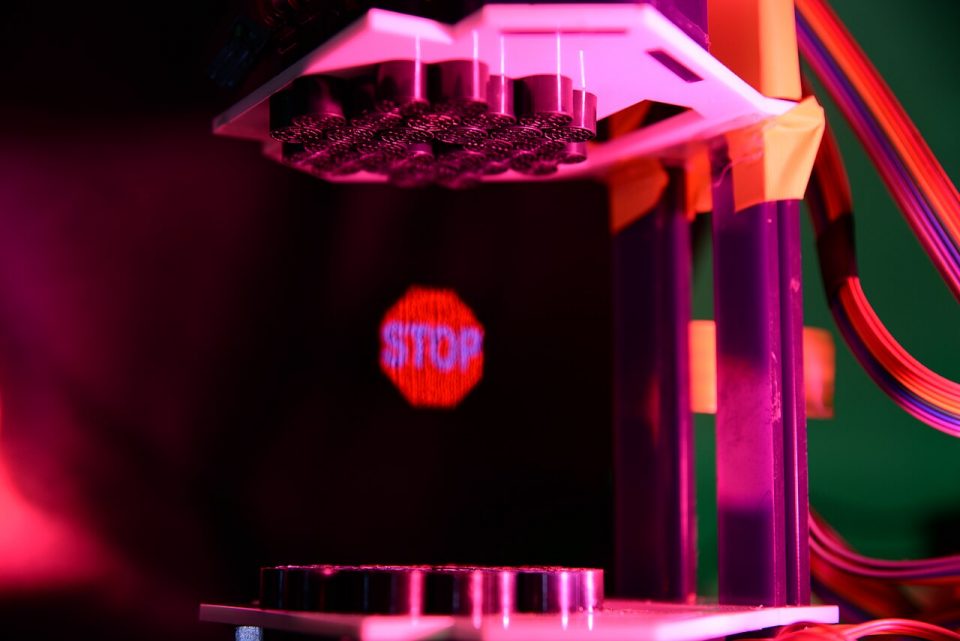
Photo 1. Volumetric projection display
The volumetric projection display developed by our team moves small particles levitated by acoustic levitation rapidly through space under LED illumination,
thereby displaying information from a PC or smartphone in midair.(Photographed by FUSHIMI Tatsuki)
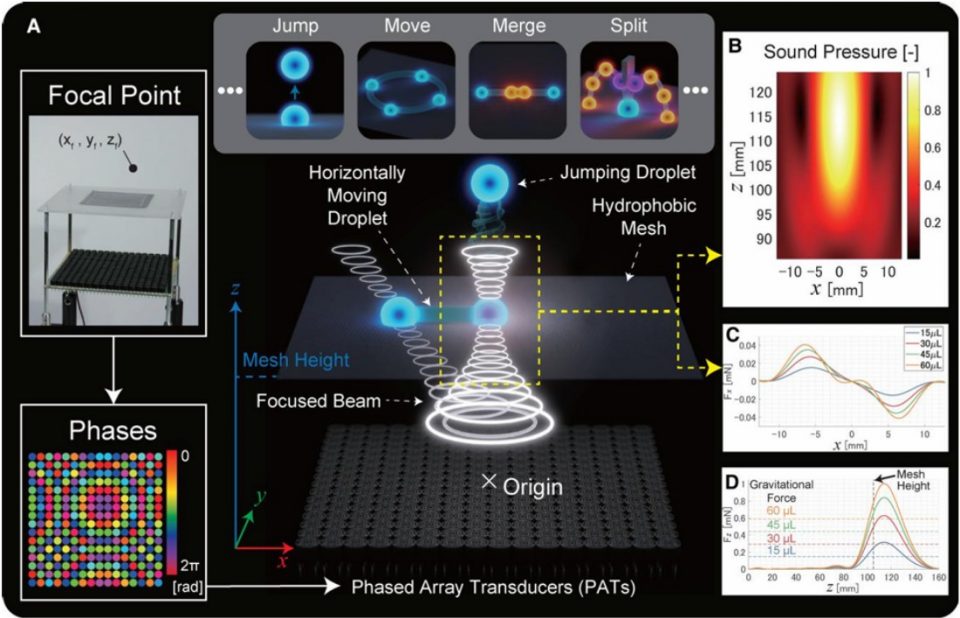
Figure 2.Ultrasonic phased-array system for automated experiments
A system that automates experiments by manipulating droplets placed on a hydrophobic mesh using ultrasound.
(Images provided by Yusuke Koroyasu, Digital Nature Group, University of Tsukuba)
Y.Koroyasu, et al., Microfluidic platform using focused ultrasound passing through hydrophobic meshes with jump availability,
PNAS Nexus, Volume 2, Issue 7, July 2023, pgad207, https://doi.org/10.1093/pnasnexus/pgad207
Advancing Toward Further Breakthroughs with an International Research Team
One of the key strengths of my research team is our international network of collaborators. I lived in Germany from the ages of 9 to 18 years, and encountered acoustic levitation during my doctoral studies at the University of Bristol in the United Kingdom. I moved to the University of Tsukuba in 2020, and I hope to leverage my connections with leading researchers overseas to link researchers in Japan and abroad while helping to drive progress in this field.
Looking ahead, I will continue to build a strong global network of people who share the excitement and potential of this research, and accelerate our work toward the future.
(Date of interview: June 31, 2025)